 |
|
||||||
 |
|
|||||




 |
 |
 |
 |
 |
 |
 |
 |
|
|
||||||
|
|
|||||
|
|
|
|
|
|
|
|
|
|||||||
 |
|
|
Thread Tools | Display Modes |
|
|
|
#1
 02-07-2013, 06:27 PM
|
||||
|
||||

Quote:

|
|
#2
02-07-2013, 07:42 PM
|
|||
|
|||
|
Quote:
The pictures of the presses of the era look like the cylinder is rather large, so they could have done it differently. 19x24 is a traditional paper size. If you can stand toread through it there's a good look at paper standardization here http://www.cl.cam.ac.uk/~mgk25/volat...papersizes.pdf Looks like the sizes weren't standardized much until after WWI and serious standardization not till after WWII. Steve B
|
|
#3
02-07-2013, 09:24 PM
|
||||
|
||||
|
ok...
Thanks again, Steve. I've been asking these questions because I keep hearing that 17 cards (as an example) cannot fit on a sheet that is 19 inches wide.
One of the standard paper sizes referenced in that PDF is 17x28. Imagine if the sheets were pressed as below (image from T206Resource.com rotated 90 degrees). Six cards could fit in the "row" (2.625*6 = 15.75) and you could have 17 cards in each "column" (1.4375*17 = 24.4375). Perhaps that's too much "waste" at the top and bottom (~1.75 inches each), but 17 cards would definitely fit, right?
|
|
#4
02-07-2013, 09:44 PM
|
|||
|
|||
|
Quote:
It might still be difficult to figure some groups, like the 14 Sl cards without Hindu. And the 150 onlys are more than just a simple group even being small. It also assumes running a sheet through a 19" press the long way. I'm not certain that was possible or good practice. Of course then I'm assuming a maximum press size of 19". You see how the reasoning can get very circular. And I haven't even floated the idea of a very complex layout, which is suggested by the plate scratch. Some of the cards may not have been in square blocks, but in diagonal rows. Two of the blocks I've pieced together might go together like that. That's why I decided to look for something like the plate scratch. It will eventually provide some concrete evidence of sheet minimum size. If I'm lucky it will lead to a complete sheet, but it may not. At least with Stamps there are usually pairs and blocks to build from, and the records about sheet size still exist. Steve B
|
|
#5
02-08-2013, 06:40 AM
|
||||
|
||||
|
Quote:
Of course, these are all guesses, not absolutes. I don't think anything yet has disproved the 17 or the 6 card row hypotheses... or that the numbers didn't change on different print groups or press runs.
|
|
#6
02-08-2013, 09:42 AM
|
|||
|
|||
|
Quote:
Steve I definitely agree with you on these two comments of yours...... 1st...... "19x24 is a traditional paper size." I have seen American Litho. (ALC) Tobacco advertising posters and other types of lithographic artwork of ALC on exactly 19" x 24" size cardboard. Medium size printing presses were designed to accomodate this standard paper (cardboard) width of 19 inches. 2nd...... "It also assumes running a sheet through a 19" press the long way. I'm not certain that was possible or good practice." A NO-NO. Rotating the so-called "34-card" sheet 90 degrees (as shown in above post #33) and printing it in this manner is impractical, and is an inefficient waste of cardboard. As, the width of such an arrangement is only 15 3/4 inches (leaving 3 1/4 inches of the 19-inch cardboard blank). Here is the simple solution for those who claim that ALC printed T206's on a "34-card" sheet...... Simulated basic sheet of 36 cards of the 34 subjects (Factory #649 overprints), of which Powers and Matty (white cap) were Double-Printed. This sheet can be extrapolated to comprise of 2 arrangements of this format (72-card sheet), or 3 arrangements of this format (108-card sheet). 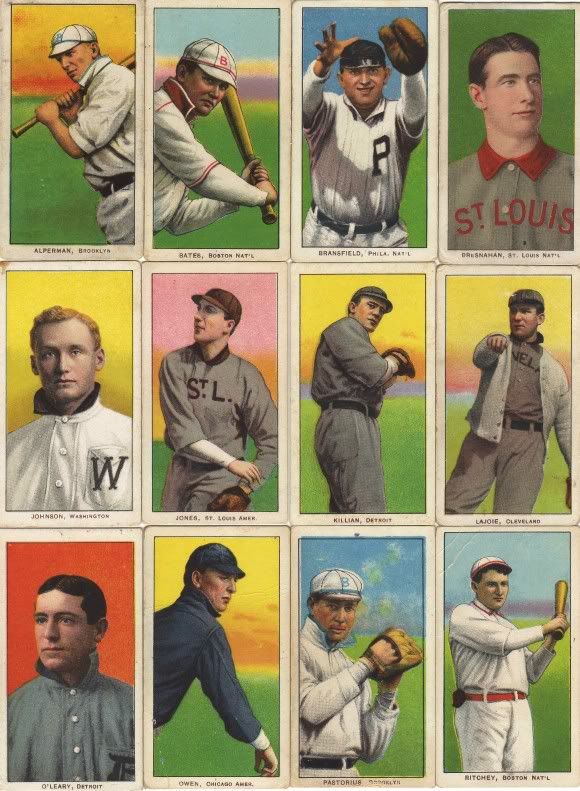 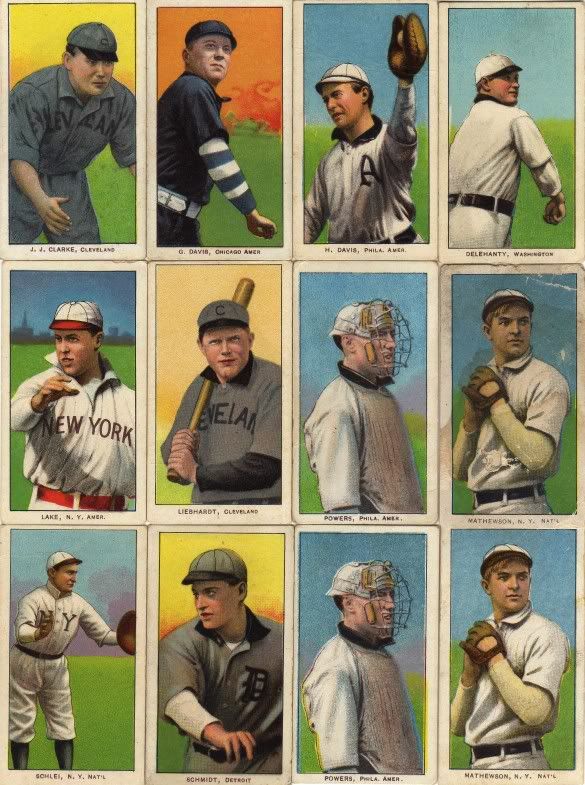 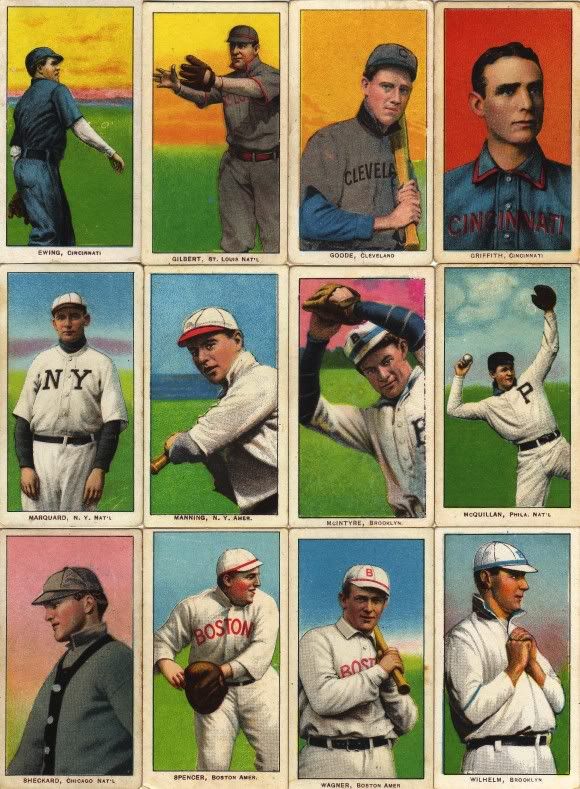 DOUBLE-PRINTS.................................................. .................................................. .................................................. ...... Powers .................. Matty FYI......regarding the practice of Double-Printing during the 20th Century of the major BB card issues. On display in this thread are quite a number of pictures of uncut sheets of BB cards, check it out........ http://www.net54baseball.com/showthread.php?t=151780 TED Z Last edited by tedzan; 02-08-2013 at 11:07 AM.
|
|
#7
02-08-2013, 11:59 AM
|
|||
|
|||
|
Quote:
Points 1 and 2 combined argue against the cards being done on a 19 inch press. To run 19x24 that means the other pieces would have been run with the narrow end going in first. That's what I'm unsure of. But if they had some 24 inch presses the 19x24 could be run normally - wide end pointing in. I should check the old printing book I found to see what the practice was at that time. The presses printing from stones are different enough from ones made even 20 years later that the details of operating may have been different. Our little press ran stuff through the long way. the 35 and 24 inch ones ran it through the short way. I suppose they could have done smaller stuff differently but never saw it done. Margins around 1.75 would be wasteful, but aren't absurdly large. A few jobs we did had margins around that size. I took some of the cutoffs from a label job home and had sticker materials enough to last for years just in 8x2 inch strips with a bar of color along one side  Steve B The point about doubleprints is a good one. There are plenty of layouts that would allow that with nearly any size sheet. It's certain there were multiples of most cards on the sheet, but how many of each and wether that was constant for all cards is uncertain.
|
|
#8
02-09-2013, 05:18 PM
|
|||
|
|||
|
Simulated T206 sheets....check them out
Quote:
Steve Thanks for your support of the argument that I've been making with respect to the Double-Printing of certain T206 subjects in order to fill out a 36-card, or 48-card, or a 108-card (19" x 24") printer's sheet. I see this not only in the SWEET CAP 150 (Factory #649 overprint) sub-set; but, also in the brown HINDU series, and in the 460-only series (as I've noted above in that thread that I provided a link to). TED Z Last edited by tedzan; 02-10-2013 at 12:05 AM.
|
|
#9
02-15-2014, 08:29 AM
|
|||
|
|||
|
Hey Steve B.
Quote:
Earlier in this thread you appear to be in agreement with someone's suggestion of printing a "34-card" format the "long way" on a 19" x 24" sheet of cardboard. I agree that this is not good practice....but more significantly, it is mathematically impossible to print a complete sheet of 34 cards on this sheet in this manner. When you do the math (17 x 1 7/16" = 24 7/16") it exceeds the length of the 24" cardboard sheet. TED Z
|
|
#10
02-15-2014, 09:24 AM
|
||||
|
||||
|
Quote:
I understand you said this was considered a "smaller job" but without business records, invoices, etc. this is (in my opinion) an assumption. We know they ran larger presses- it's not hard for me to imagine that they would print sheets on a press that would take a "slightly" larger sheet-just sayin'  Sincerely, Clayton
|
|
#11
02-15-2014, 09:46 PM
|
|||
|
|||
|
Quote:
I lean more towards your theory of 12 subject sheets and tried to use the pop report numbers to disprove his groups. And as far as I'm concerned his groups held up very well. At some point I hope he shares what he's come up with more widely, but that's up to him. The Hoe #5 did have a 19" track, and the floorplan shown in the old article did show several hoe #5 presses at ALC. I believe the article was in scientific American but their archive is behind a paywall now and I can't find the copy I thought I'd saved. I also couldn't find the Hoe press ad I'd seen. But that was only a diagram of one floor of a very large firm. Most large printing plants have several sizes, unless they're doing huge volume of only one sort of item. A newspaper would only have one very large fast press, but a general business would have at least a few different sizes. There is a lot of small detail that leads me towards believing a far more complex situation for the sheets. 1) There are groups that work perfectly with a 12 subject sheet. BUT there are also groups that Just don't and many of those either are or are much closer to 17/34 2) The fragment of packing log that specifies "other than philadelphia area" implies a different group of cards for that area. The easy way is to make a different sheet so there's no concern about mixing up which players went where. (Alternately they could have pulled the players they didn't want to send to phillly, OR perhaps ALC packed them in stacks of one player. Short of some miracle, we'll probably never know. A sheet turning up is more likely than an intact boxful sent from ALC to any of the factories) * 3) There's a lot of evidence for each of the current groups being sent to press multiple times for the same brand even within a series. Examples Tinker hands on knees - Normal, with traces of Chicago showing underneath cubs, and with Chicago showing clearly. At least two distinct runs, probably three. Dygert - Comes both with and without red lips. In roughly equal quantities, so it's not a missing color or fading. Obviously the Demmitt and Ohara show that the sheets were redone at the very least for Polar Bear. Conroy fielding and Ritchey - Both have differences that split clearly between 150 and 350 backs. Wilson - Orange or yellow sky. They're actually quite different, and it ought to be a more recognized variation. Certainly it's more of a different plate situation than Nodgrass or Dopner. There's more, most of it much less obvious. 4) If we assume a simple sheet with a straightforward layout, and the same sheet used for all brands those subjects were available with then the pop report numbers should have roughly the same distribution across brands. This is generally true for Piedmont and Sweet Caporal, but breaks down for the other brands. So either there are some odd patterns to what cards get sent in, or the sheets for some brands were entirely different. 5) Hoe made 2 color presses, and I see some indication that some T206s may have been printed on a 2 color press. Quite often when there's a small color shift two colors are shifted equally. The Hoe#5 wasn't two color. 6) The number of dual name cards compared to simple miscuts showing two of the same name I think supports at least some sheets having an unbalanced arrangement. So I suppose both the 12 subject guys and the 17/34 subject guys can call me a heretic. I think what's likely is that for brands like Hindu the sheets were 12 subjects. And for Piedmont they were probably 17/34 maybe more. So both camps are probably both right and wrong all at the same time. Confused yet That's why I like the wide range of efforts. Tracking the double name cards, the plate scratches, the factory numbers in the margins, the cutting marks (Why the Heck are they on the back when the cutting was done from the front?!) All that and more will eventually give us a much better picture of the production. I also think we need to redefine the print groups. (Sorry Scot) And to look at each brand and series as its own set. At the level of the basic subjects there's a lot of overlap, but when the small details are looked at there's probably a lot less, possibly none.(So a common subject front will probably have small but identifiable details with no crossover between brands. ) To me it's more about what's possible, what would make sense in a manufacturing context, and what part of that can be proven. I know my own theories are pretty far out there, and may not be something I can prove or disprove within my lifetime. (There are people who have done the same thing for stamps and taken decades to chart a handful of plates for one stamp. And that's comparatively "easy" since the sheet size is known and usually there are blocks of stamps available) Steve B * But damn, can you imagine one of the packers or loading dock guys or even a janitor liberating an entire boxful of Wagners or Planks before it hit the dumpster? 
|
|
#12
02-16-2014, 01:49 AM
|
||||
|
||||
|
Some of this information may seem obvious to most, but I'm going to include it anyway for some of our new board members.
I believe that the printing of T206 sheets was very compact and not much border was left to be trimmed. As Ted said in post #131, "printers do not like to waste paper". And I agree with him. If the sheet borders were more spacious, we probably wouldn't see sheet numbers or crop lines on the backs of T206s. One could expect to see a sheet number or crop line on a T206 if it had huge borders, but actually its the opposite. T206s that have sheet numbers and crop lines are usually standard size T206s. I do believe the Young and Stahl cards may lend us some clues to sheet size. As far as sheet dimensions, I can't really add any information since I've done no research on that matter. I also have no idea how the sheets were cut, so I'm just theorizing with what I post below. I think its safe to say the Young and Stahl cards were at the top of the sheet/column. If they were in the middle of the column and miscut that bad, they would look like the Phillippe/Engle card. (see below) Also the Young and Stahl cards show no major print defects. Neither have a ghost print or a color shift and since both have a back advertisement, one could conclude that they we "finished product" waiting to be cut from the sheet. I think the third cut that was performed along the bottom of these cards was the cut that ruined the card's appearance, but it also lends us a glimpse at how much sheet border remained above the player's image. I boxed the Stahl card (see below) as to where the top border should have been cut. So is the excess paper above my red line remnants of the sheet border that would have been removed on the final cut? Keep in mind the Young card is not oversized. I will post a comparison scan below courtesy of Dan M. I have not seen the Stahl card other than the scan posted earlier in this thread, so I'm not sure of it's measurements. If a person were to measure either of these cards, I think we could get an idea as to how much of a sheet border actually existed before the final cut was made. One last thing I would like to add. I have to agree with Ted Z. in the fact that the 12 players he refers to as the "Exclusive 12" were on a sheet together. I posted a thread back in 2010 about these same players being on a sheet together and have seen no evidence since to make me think otherwise. Jantz
|
|
#13
02-16-2014, 09:09 AM
|
||||
|
||||
|
Quote:
You actually made the point I was trying to make earlier when you said the following: "The Hoe #5 did have a 19" track, and the floorplan shown in the old article did show Hoe#5 presses at ALC. I believe the article was in Scientific American but their article is behind a paywall and I can't find the copy I thought I'd saved. I also couldn't find the Hoe press add I'd seen. But that was only a diagram of one floor of a very large firm. Most large printing plants have several sizes, unless they're doing huge volume of only one sort of item. A newspaper would have only one very large fast press, but a general business would have at least a few different sizes." The point I was trying to make, simply, was that the ALC ran different sized presses. I confirmed through the Library of Congress that they have ALC lithograph advertising posters measuring 22"x28" from the same timeframe. These dimensions are NOT that much larger than "19x24". We are talking 3" one way and 4" another. So, no argument that they ran Hoe #5's with a 19" track- just that they also ran presses that could do pieces slightly bigger. And, since we don't have an actual sheet of T206's, *my opinion* is that we shouldn't be letting the dimensions "19x24" be the guiding light end all is all. With that being said-IF the ALC only ran one size press- you wouldn't have heard a peep out of me about this. Also, I am not saying anyone is wrong when it comes to the numbers 6, 12, or even 48 subjects to a sheet doubled. I am intrigued by this, just as I am by 34 subjects with a horizontal row of 17. Most members have been to T206Resource, but to those new members who haven't, Tim wrote a great article about "Sheet Mystique", and I recommend everyone who loves T206's to check it out: http://t206resource.com/Article-T206...stique-34.html Steve- I appreciate you being open minded and I really enjoy reading your posts. Jantz- Same goes for you, I always enjoy your posts as well, and I agree that the Young and Stahl cards could have some of the clues we are looking for. Thanks for posting those So much for the sidelines  Sincerely, Clayton
|
|
|
|
 Similar Threads
|
||||
| Thread | Thread Starter | Forum | Replies | Last Post |
| W565 Black Sheet w/ Harry Heilman, nrmt Al Simmons plus partial red sheet -$110 DLVD | kylebicking | Pre-WWII cards (E, D, M, etc..) B/S/T | 1 | 01-14-2013 10:13 PM |
| FS: Large Uncut Sheet lot (w/ 1984 Fleer Update sheet) - $800/OBO | jimivintage | 1950 to 1959 Baseball cards- B/S/T | 0 | 04-21-2011 10:58 PM |
| F/S T206's....Baker P460/42 (SOLD)....check-out 8 add. T206's | Archive | Tobacco (T) cards, except T206 B/S/T | 5 | 03-30-2009 02:46 PM |
| Check-out this T206 lot ? ? | Archive | Net54baseball Vintage (WWII & Older) Baseball Cards & New Member Introductions | 7 | 06-23-2007 10:56 AM |
| 24 Player Old Judge Sheet on ebay - check this out!!! | Archive | Net54baseball Vintage (WWII & Older) Baseball Cards & New Member Introductions | 7 | 06-26-2003 11:18 AM |


 Hybrid Mode
