 |
|
||||||
 |
|
|||||



 |
 |
 |
 |
 |
 |
 |
 |
|
|
||||||
|
|
|||||
|
|
|
|
|
|
|
|
|
|
|
#1
 06-06-2014, 10:12 AM
|
|||
|
|||

Quote:
Thanks for the extensive response. I don't know that the auction houses were putting a positive spin on it this way. Just that they were mentioning it and I wanted to understand the ramifications. The focus of my collection are items that are at the nexus between baseball and general history so there aren't a ton of items I am really looking to buy (especially since my preference is signed baseballs). I picked up a couple of WWII team signed baseballs from the Musial Estate Auction from Heritage a year ago and both of them have shellac on them, and picked up a 1931 US tour to Japan team signed ball and it too has a layer of shellac. Aesthetically for me they all look great (I actually like the look of the browned Musial ball) partially because of the uniqueness of the item and the fact that this is how Musial had the ball and I was comfortable with the prices I paid, but I wanted to better understand the relevance of the shellac. This Musial definitely displays some of the effects you mention:  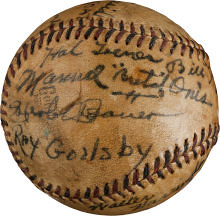  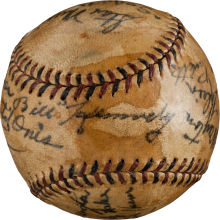 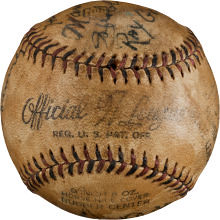 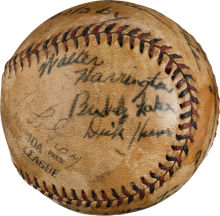 While the 1931 AS one looks a little cleaner:      

|
|
#2
06-06-2014, 10:20 AM
|
||||
|
||||
|
Quote:
I only have one shellacked ball (I would never say that anywhere but here), and while nowhere near as nice as yours, I think it looks pretty good:
__________________
$co++ Forre$+ Last edited by Runscott; 11-30-2014 at 01:15 PM.
|
|
#3
06-06-2014, 11:10 AM
|
||||
|
||||
|
Great stuff... and with regard to this topic, beauty is definitely in the eye of the beholder. Some of those older balls look pretty cool with the shellac, as referenced above.
My personal fear is that the shellac could flake off and take the prized signatures with it. Just a little pessimism with some OCD sprinkled in for good measure. That's why I've personally avoided them. If you look at prices realized in the major auctions, you'll see the general collecting population feels the same. Of course a lot depends on the severity of the shellacking. Not sure why some shellacs and varnishes flaked and changed color, and others didn't.... Perhaps it was the particular brand of shellac Perhaps it was the way in which the varnish was applied (i.e. sprayed vs. brushed on) Perhaps it was the storage method and/or exposure to the elements (light/heat/cold/humidity) over the years Maybe someone here with a science degree can chime in and enlighten us a bit more 
|
|
#4
06-06-2014, 11:36 AM
|
||||
|
||||
|
hopefully
such a discussion won't devolve into "when water is not a chemical".......
|
 |
|
|
 Similar Threads
|
||||
| Thread | Thread Starter | Forum | Replies | Last Post |
| baseball's falling popularity and its affect on our hobby | honus94566 | Net54baseball Vintage (WWII & Older) Baseball Cards & New Member Introductions | 148 | 01-31-2014 10:03 AM |
| Just how much does condition affect value? | jasonc | Net54baseball Vintage (WWII & Older) Baseball Cards & New Member Introductions | 26 | 12-30-2013 10:42 AM |
| Shellac on Ball | Zach Wheat | Net54baseball Sports (Primarily) Vintage Memorabilia Forum incl. Game Used | 6 | 07-22-2011 11:10 PM |
| How Badly does Trimming Affect Value? | Archive | Postwar Baseball Cards Forum (Pre-1980) | 6 | 12-14-2007 03:17 PM |
| Question about creases and how they affect value | Archive | Net54baseball Vintage (WWII & Older) Baseball Cards & New Member Introductions | 9 | 06-04-2006 07:33 PM |


 Hybrid Mode
