 |
|
||||||
 |
|
|||||



 |
 |
 |
 |
 |
 |
 |
 |
|
|
||||||
|
|
|||||
|
|
|
|
|
|
|
|
|
|
|
#1
 03-06-2016, 06:22 AM
|
||||
|
||||

III. Tips For Getting Started Once you have everything you need-the starter kit, the supplies to store your cards safely, and the information to familiarize yourself with the collecting niche you've decided upon, it's time to start buying cards. I. The very first piece of advice I'd give to a new collector is to start small. Though that T206 Cobb, or 1953 Bowman Color Mickey Mantle might wow your socks off, those cards will cost quite a bit to acquire. And, if you're going to buy one of those cards, you really want to know what you're doing first. I referenced creating a "starter's kit" earlier, and provided a small list of items that every collector should have. I would also add baseball cards to that list. I've created a small collection of commons for all the years I am collecting, and whenever I buy a card from a particular set, I compare any card I get in to the common card. These commons won't be expensive. You don't even need a high quality common. In fact, it's probably better if the commons have a little bit of wear. I even purchase a few pretty beat up cards from each decade, ones exhibiting issues like water damage, creases and wrinkles, paper loss, edge and corner damage. II. Get to know the cards you are buying. Say you've decided you want to collect 1953 Bowman Color cards. Great choice! Before you go buying a Stan Musial, a Mickey Mantle or a Pee Wee Reese, pick up one of those commons I referred to. You want to become familiar with the card stock used to produce your favorite set. Look at the common card under magnification. Learn to recognize how the edges of these cards look under your loupe. This section on the Net 54 website serves as an introduction to spotting alterations, forgeries and reprints (scroll down the page to see this). One of the biggest problems you will be faced with as a collector is trimming. Trimming is a form of alteration where a card with "soft" edges is sliced off, slightly, to create the appearance of a sharper edge (or corner), which, of course, would make the card more valuable. Take one of your commons, an x-acto knife, and a ruler, and cut along the edge. Look at the cut edge, and compare it to one that has not been cut. Examine the edges for signs of chipping, a natural byproduct of normal card production. While there are other things to be looking out for (ie bleaching, re-papering of cardboard loss, soaking, etc), trimming is one way an unscrupulous seller can try to pull a fast one on a buyer. A trimmed card immediately lowers the card value, though it might improve upon its visual appeal. If sent to a company like PSA, Beckett, or SGC, a card grader would recognize this alteration, and label the card as altered. Never assume that a card you've purchased is unaltered. It's your money, and a proactive collector will experience less heartache. By familiarizing yourself with the look, and the feel of the cards you are going to collect, you immediately reduce the likelihood that you're going to get taken for a ride. You can even do as I do, and "smell" cards when you get them (if they're not entombed in a graded card slab, of course). That's not a joke. A 40 or 50 year old card will have a different smell than a card that was produced a month or two ago. While printing technology has advanced quite a bit from 1953, that can also work for you. A reprinted card might look like the real thing at first glance, but if you are careful, and using all of your senses, you should be able to tell the difference. The smell, the feel, the appearance--something will just "feel" different. Just remember, once you've done your due diligence, it's okay to ask questions. You can examine something and still not be sure. It's always smart to ask for help, especially when you're going to spend a considerable amount of money on a single card for the first time. If you're not sure, start a topic on the correct forum (here for vintage cards, and the main forum for pre-war). If it's an auction you're unsure of, provide a link, and as much information as you can. If it's a card you're looking to buy in person, take a picture (or, even better, a scan) of the back and front of the card, preferably without any top loader, etc (if this is feasible). Reprints and forgeries will each have tell tale signs, and experienced collectors will know what to look for. By asking questions, you will learn from the knowledge and experience of veteran collectors. These gems you learn will help protect you. Knowledge is power, and the scam artists out there are counting on an uneducated buyer to make their money. III. Buy from only trustworthy sources. So, you're looking to buy that killer 1957 Topps Roberto Clemente. You've been looking on EBay, and boom, there it is. You click on the link, and the card you see is beautiful. Do you click on the buy it now, and shoot off a few hundred bucks of Paypal to the seller? No. God, I hope not. At least, not until you've done some real scrutinizing. The first thing you should do is look at who you're buying from. If you're seeing a seller with the user name Somenewguy101 (5), you need to be on your guard. Is it possible they are a legitimate seller, and the card you are looking to buy is authentic? Of course. Even the most trustworthy sellers on EBay started out at one time, so a low feedback score is not indicative of a person's trustworthiness. Likewise, somebody with a 10,000 feedback score (and a 100% approval rating) is not guaranteed to be selling the real deal. Let me allude back to my investment experience. You've all heard of Bernie Madoff, correct? He was an investment advisor that swindled millions from his clients. Before his crooked ways were exposed, he had a good reputation, and wealthy investors trusted him with their money. Never assume. Don't let a 100% approval rating lull you into a false confidence. You need to be like a CSI, weighing all the evidence. You need to be looking at the EBay post (or wherever you are looking to buy) itself. Is this a picture that somebody pulled off the net, and slapped into their auction? Or, does the picture have their user name on EBay included with it? There's a site that does searches by image called Tineye. You provide the image URL (web address), and it scours the web for that same picture. If you're buying a card, and the identical picture is coming up thousands of times, then you have to consider if you're not looking at a reprint. Is the seller providing multiple, clear pictures of the card (and card slab, if it's graded), or is there one blurry picture of the card in one of those lucite card blocks of doom? Read the information included in the auction. Are they dealers? Or, did they "find this card in their grandfather's attic"? Use common sense. Look, too, at the seller's EBay history. Have they sold similar vintage baseball cards before? If not, that in and of itself does not mean they are up to no good. But if they sell like-valued cards, then it increases the likelihood that the card is authentic. All of this is important to read, and consider. If you have questions, or concerns, contact the seller! A legit seller will provide information, and additional pictures. A scam artist won't respond, or they'll come up with an excuse as to why they can't provide other pictures. And look over the pictures that are provided. If it's a PSA 8 you're buying, does the card's condition exhibit what you'd expect for the grade? As an example, here's a visual representation of how PSA grades their cards. This shows several different 1952 Topps Mickey Mantles, one at each different grade level from Gem Mint 10 all the way down to Poor 1. If it's a graded card, are there frosted borders to the slab? Is the slab damaged? Does the flip look...off? Is the typography used inconsistent with the font PSA has long-used? Is the spacing off between letters and numbers? If after all of this, you're still not sure, ask for help on the forum. The B/S/T (buy/sell/trade) on Net 54 is an excellent place to buy and sell cards. This is a community of hobbyists, and we do all we can to police the B/S/T, and the hobby itself. But you should always keep your guard up. Listen to the little voice in your head. If something doesn't feel right, ask for help, or don't buy. Unless you're hot for a one of a kind card (or an ultra rare issue), chances are there will be another example of the card you're looking for available very soon. A good collector never acts irrationally. Patience is a virtue. This is a great hobby. But, as with any other investment, a certain amount of education is necessary to trade, buy and sell safely. Don't ever let yourself be pressured into doing something you're not comfortable with. Use your resources. In doing so, you'll avoid getting taken advantage of. IV. Lastly, have fun! Remember why you love baseball, and collecting cards in the first place. The hobby can be a little intimidating in the early stages. There are some really valuable cards that change hands. Remember, this is something to do for your enjoyment. It's not a competition. Don't ever hesitate to ask for help when you have questions. Read the forum, and contribute. "Pay it forward" if you can. Once you've been collecting for a while, share the knowledge you've acquired, and help those who are just starting out. That's the kind of spirit this hobby needs more of. If you have any questions, please feel free to message me. I check the forum at least every few days, and I'm happy to help. Bill
__________________
Building these sets: T206, 1953 Bowman Color, 1975 Topps. Great transactions with: piedmont150, Cardboard Junkie, z28jd, t206blogcom, tinkertoeverstochance, trobba, Texxxx, marcdelpercio, t206hound, zachs, tolstoi, IronHorse 2130, AndyG09, BBT206, jtschantz, lug-nut, leaflover, Abravefan11, mpemulis, btcarfagno, BlueSky, and Frankbmd. Last edited by the 'stache; 03-07-2016 at 10:52 AM. 
|
|
#2
03-06-2016, 06:25 AM
|
||||
|
||||
|
One additional thought regarding graded cards. It is very important to maintain a healthy level of skepticism whenever buying cards, even those that have been graded, and "slabbed" by reputable companies like Professional Sports Authenticator (PSA), Beckett, and Sportscard Guarantee (SGC). Never assume that a card is authentic because somebody else tells you it is. There are people out there that try to make money off of unsuspecting collectors, using these graded card cases to further their scams.
This is what PSA's slab looks like without a card, or a "flip" (the printed portion at the very top of the slab which includes the name of the player, the year and company that has produced the card, the card number, and the grade.) 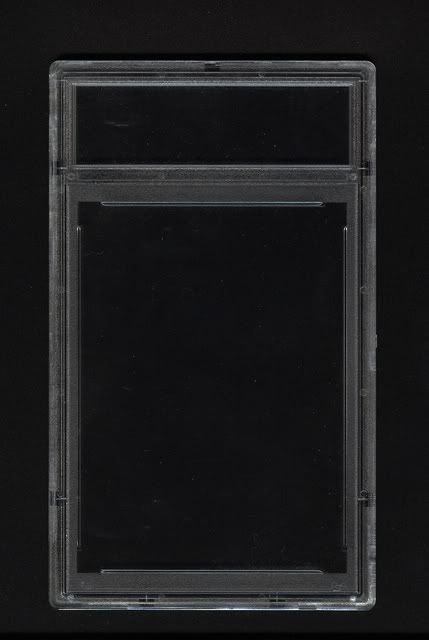 Placed against a black background, you can see what the plastic slab looks like. Upon inspection, you want to be on the lookout for abnormally "white" portions of the slab, which can be indicative of the slab "being popped". This is referred to as frosting. While a little bit of light frosting is common in the production of these slabs, more pronounced frosting is often the first sign that a slab has been tampered with. And when I mean tampered with, I mean opened to remove the original card, and replace it with a lesser quality card, or a fake. Though the slabs vary from one company to another, common practice is to "sonically weld" the top and bottom pieces together, forming a strong seam. These seams can be exploited, however. There are videos on Youtube you can look up to show how this is done. Basically, an x-acto blade, and a screwdriver head, weaken the seam, and pry it open. Besides the bright white frosting that is evident, you also want to test the strength of the slab itself. Holding the top portion of the slab (near the flip), and the lower portion, try to gently bend the slab. If there is any give, you want to immediately examine the card itself. Even if there is not any give, you still want to examine the flip along the seam, looking for signs that it's been cracked, and re-glued. Look for micro-fractures. Keep in mind, too, that occasionally, the TPG (third-party graders) change their flips. They might alter how the information is layed out, or add additional information to the flip. If you are unsure about a flip, search the internet to find examples of old flips. Or, ask somebody on the forum to take a look at it. Scammers try to steal from buyers with these graded cards in a few ways. One approach is to crack open a legitimately-graded card, so they can remove the card, and replace it with a card of lower quality. Say, for instance, the scammer has a 1957 Topps Mickey Mantle that PSA has graded an 8. They would pop this, and replace it with a 6, and sell it as the 8. The card would command the higher price an 8 would fetch on the open market. This is where the examination of the slab, the flip, and the card itself are important. Another approach scammers use is to replace the legitimate cards with reproductions, either reprints, or forgeries. Reprints will often have the word "reprint" included on the back of the card somewhere (but not always), and the cards will often exhibit some minor difference from the original. Be on the look out for alterations to the card backs where the word "reprint" would normally be found. In this example, a legitimate slab + flip are used to sell a card that is not authentic. Lastly, the other option crooks have is to use slabs and flips that have been created for the purpose of stealing from the consumer. These do not come from the legitimate TPGs. They are produced in other countries. The flips, too, will be faked. This is where a loupe is helpful. Examine the typography utilized on the flip, and compare it to an authentic example. The mantra of "buy the card, not the holder" should ring in your head whenever you buy a graded card. If you are buying a card in person, examine the card itself, the slab and the flip. If you are buying a card online that has been graded, look over the pictures provided...carefully. Does the card entombed in plastic match the grade on the flip? Does the slab exhibit any examples of tampering? Does the flip, and any hologram used, look right? And as always, does the seller pass the sniff test? I don't want new hobbyists to be frightened by the information I am sharing. This is a great hobby, and the vast majority of people who collect are in it for the right reason. You just need to always be on the defensive. You need to be proactive. Even if you are buying a valuable card from a trusted seller, still go through these steps. Because while the TPGs go to lengths to insure the safety of the public, card graders are human, and can make mistakes. Never assume that your seller's card is authentic. Sellers can be duped, too. They can buy cards they think are legitimate, and a careful scam artist might be able to fool even the most seasoned seller if they are doing considerable volume. Establish good habits, and they will serve you well. When you buy cards online, know what kinds of protection your payment method(s) offer. Don't assume, ask! And be aware of what price the card you are looking to buy has been commanding. You can use VCP (vintagecardprices.com), or even look at EBay history for an idea. If somebody is selling a card that usually goes for $1,000 for $400 buy it now, something is amiss. The old mantra of "if it's too good to be true, it probably is" applies to our hobby, too.
__________________
Building these sets: T206, 1953 Bowman Color, 1975 Topps. Great transactions with: piedmont150, Cardboard Junkie, z28jd, t206blogcom, tinkertoeverstochance, trobba, Texxxx, marcdelpercio, t206hound, zachs, tolstoi, IronHorse 2130, AndyG09, BBT206, jtschantz, lug-nut, leaflover, Abravefan11, mpemulis, btcarfagno, BlueSky, and Frankbmd. Last edited by the 'stache; 03-07-2016 at 04:48 AM.
|
 |
|
|
 Similar Threads
|
||||
| Thread | Thread Starter | Forum | Replies | Last Post |
| O/T but helpful concerning paypal | Leon | Net54baseball Vintage (WWII & Older) Baseball Cards & New Member Introductions | 4 | 10-30-2010 09:56 AM |
| O/T...but may be helpful with paypal | Archive | Net54baseball Vintage (WWII & Older) Baseball Cards & New Member Introductions | 0 | 08-15-2007 10:21 AM |
| O/T but may be somewhat helpful | Archive | Net54baseball Vintage (WWII & Older) Baseball Cards & New Member Introductions | 113 | 12-09-2006 09:40 PM |
| vacation's over-- helpful advice for collectors | Archive | Net54baseball Vintage (WWII & Older) Baseball Cards & New Member Introductions | 5 | 05-09-2004 07:02 PM |
| helpful hint | Archive | Net54baseball Vintage (WWII & Older) Baseball Cards & New Member Introductions | 0 | 09-11-2003 07:28 PM |


 Hybrid Mode
